The Transition Nobody Prepares You For
What am I good at? What problems do I want to solve? These are harder questions than "What should I study?", especially at 16. Here's how parents and young people can start exploring them earlier.
nmomanyi · · 5 min read
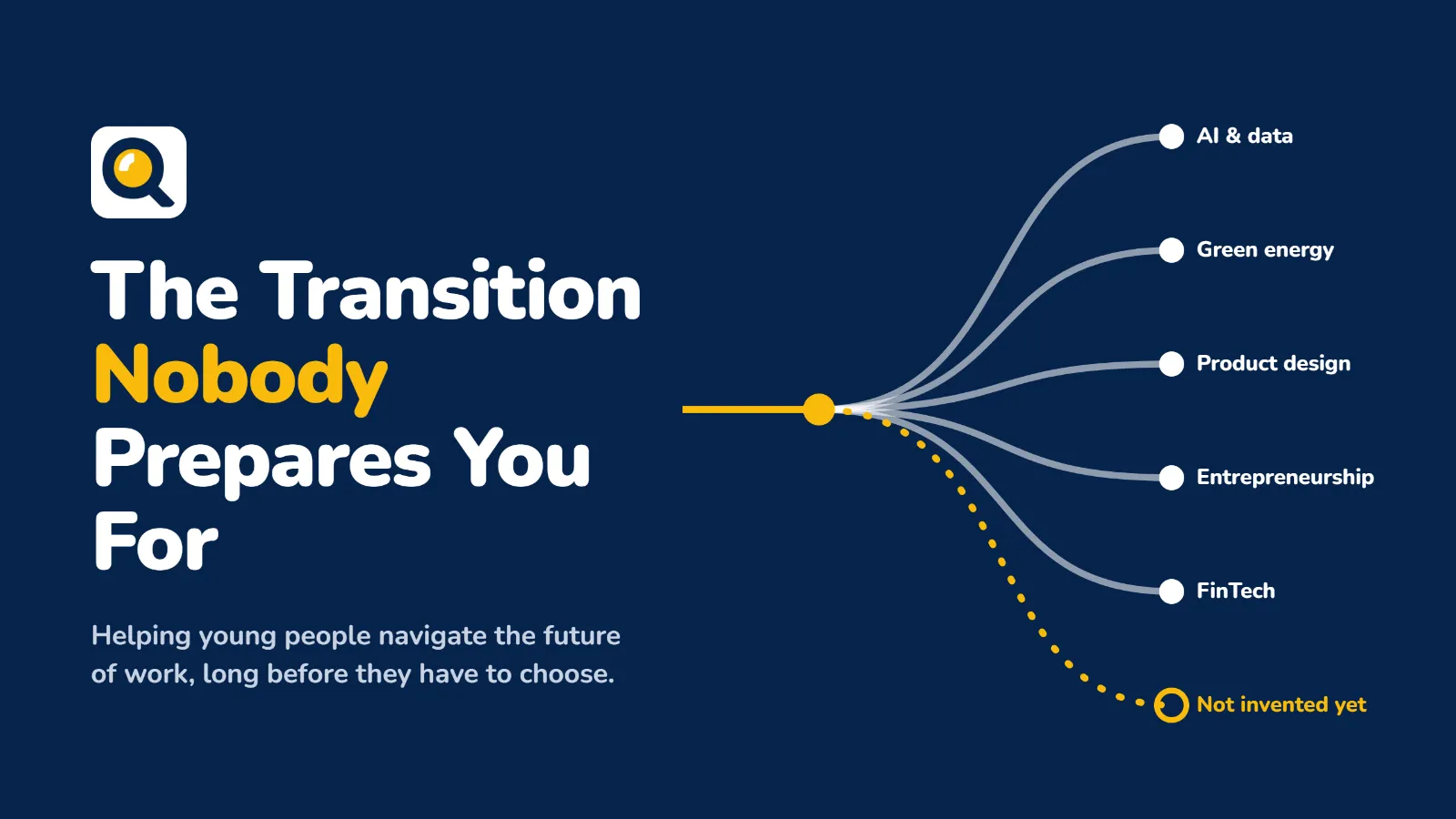
We spend a large portion of a child's life preparing them to pass exams, but what prepares them to navigate what comes next?
For the longest time, the path after school was relatively straightforward: finish high school, choose a university course, graduate and get a job.
Students were guided towards familiar pathways: STEM, humanities, business, medicine, law, education. This relied heavily on the assumption that choosing the right course would lead to the right career.
But the dynamics are changing.
The question young people face today is no longer simply "What should I study?" It is increasingly "What am I good at? What problems do I want to solve? What skills will matter? And where could my strengths take me?"
That is a much harder question to answer, especially when you are 16, 18 or even 21.
The world of work is changing
The World Economic Forum's Future of Jobs Report 2025 gives us a glimpse of just how much the world of work is shifting.
The report projects that by 2030, 170 million jobs could be created globally while 92 million jobs could be displaced, resulting in a net increase of 78 million jobs. Among the fastest-growing roles are AI and Machine Learning Specialists, Big Data Specialists, Software and Applications Developers, FinTech Engineers, Environmental Engineers and Renewable Energy Engineers.
These changes are being driven by major forces including technological change, AI, increasing digital access and the green transition.
This raises an important question:
Are we preparing young people for this reality early enough?
Career exploration should start earlier
Imagine asking a 17-year-old to make a major decision about their future when most of their exposure to careers has been limited to what they encounter at school, what their parents do, and the handful of professions they hear about most often.
How are they supposed to know what they are good at?
How are they supposed to discover careers they have never encountered?
How are they supposed to understand how their interests and strengths could translate into opportunities that may not even have existed when their parents were choosing careers?
This is why career exploration shouldn't be a one-time conversation before university applications.
It should start much earlier.
By Grade 7, young people can begin asking themselves:
- What am I naturally good at?
- What problems do I enjoy solving?
- What makes me curious?
- Do I enjoy creating, analysing, building, leading or helping others?
- What careers exist beyond the ones I already know?
The goal isn't to ask a 12-year-old to choose their career.
The goal is to give them enough exposure and self-awareness to make better decisions later.
So, what can young people do today?
Preparing for the future of work doesn't mean predicting exactly what the job market will look like in 2035.
It means developing the curiosity, confidence, skills and relationships to navigate it.
1. Find a community
Young people should have spaces where they can meet peers who are also curious about entrepreneurship, careers, technology, creativity and the future.
Camps, clubs and communities can expose a 13-year-old to ideas they may never encounter in the classroom and help them realise that other young people are asking the same questions about their futures.
2. Start the conversation at home
Career conversations shouldn't begin when university applications are due.
Parents can start much earlier by asking:
- What did you enjoy doing this week?
- What are you naturally good at?
- What would you like to learn more about?
- Is there a career you've heard about that you'd like to understand?
The conversation shifts from "What will you become?" to "What are you discovering about yourself?"
3. Get outside the classroom
School talks, competitions, entrepreneurship challenges, hackathons and innovation programmes can help young people discover possibilities they didn't know existed.
A student might discover an interest in product design through a competition. Another might discover entrepreneurship by building something with friends. Another might meet an engineer or founder and realise that a career they had never considered is actually an option.
Exposure expands the map.
4. Meet someone doing the work
During the holidays, a young person could spend a few hours talking to or shadowing someone working in a field they are interested in.
Ask them:
- What does your day look like?
- What skills do you use?
- What did you study?
- What do you wish you had known when you were my age?
A job description tells you what a career is called.
A conversation with someone doing the work can show you what that career actually looks like.
We don't need young people to predict the future
The future of work will continue to change.
There will be jobs today's teenagers haven't heard of yet. Some careers they know today will look completely different. Others may be transformed by technology.
The answer isn't to give every young person a perfect career plan at 15.
It is to help them build the ability to navigate uncertainty.
That means helping young people understand themselves, explore possibilities, build skills, meet people, experiment with ideas and remain curious.
Because perhaps the most important transition we need to prepare young people for isn't simply school to university.
It is the transition from being told what to learn to learning how to navigate the world.
Start the journey with Quest
At Quest, we believe every young person deserves the chance to discover what they're good at, explore careers they've never heard of, and build the confidence to navigate whatever comes next.
That's why we're building an app to help young people do exactly that, and we'd love for you to be part of it from the start.
Join the waitlist and be the first to know when Quest launches.
Are you a parent, educator or professional who wants to help young people explore their future? We'd love to hear from you. Get in touch at hello@myquest.africa or +254 701 878 817.